
Small-Molecule Drug Discovery in 2025
Where the Market Stands—and How Far It Could Grow by 2030–2035
Small molecules—typically orally available, chemically synthesized drugs—remain the workhorse modality of modern therapeutics. In 2025, they continue to anchor pipelines across oncology, immunology, cardiovascular disease, and CNS, thanks to their ability to reach intracellular targets, scale reliably, and follow well-established development playbooks.
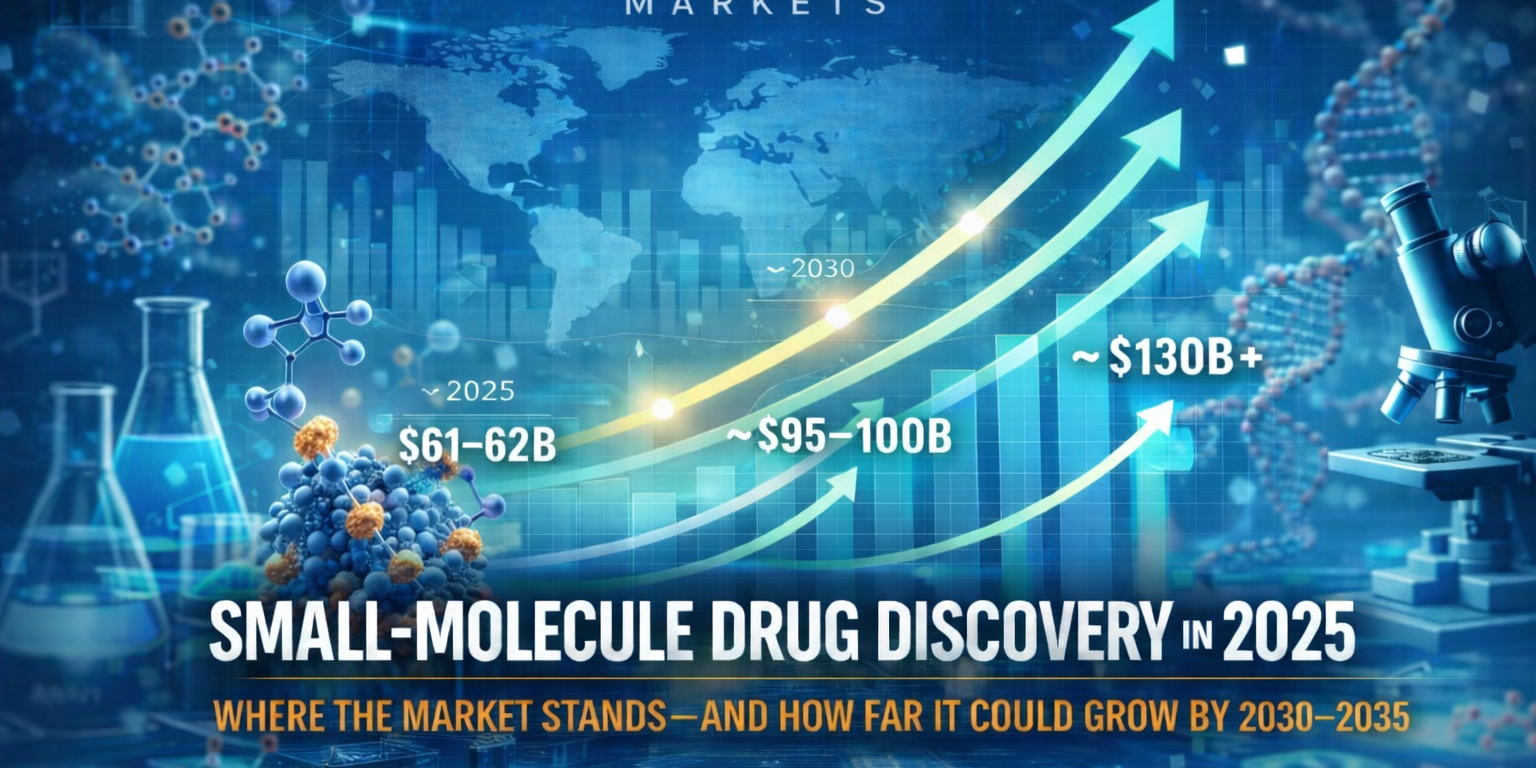
That resilience is reflected in market forecasts, which place the global small-molecule drug discovery market at approximately $61–62 billion in 2025.
Why 2025 Is a Pivotal Year
Rather than signalling a “post-small-molecule” era, 2025 marks a multi-modality inflexionpoint—where biologics, cell and gene therapies, and RNA approaches expand alongside sustained growth in small molecules.
Key forces driving this moment include:
-
New target classes
Protein–protein interactions, targeted protein degradation ecosystems, and selective RNA-targeting small molecules are expanding what small molecules can address. -
AI/ML moving from hype to infrastructure
Drug discovery organizations are building real platforms—data foundations, shared datasets, and modeling pipelines—to accelerate protein–ligand design cycles and improve hit quality. -
Outsourcing and virtual pharma models
More discovery work is shifting to specialized CRO and CDMO partners, reducing fixed costs and speeding iteration loops.
Together, these forces matter because discovery is fundamentally an iteration game: faster design–make–test cycles translate directly into more viable pipeline shots.
Market Size in 2025: One Market, Multiple Lenses
Forecasts vary depending on how “drug discovery” is defined—but the overall picture is consistent: a large base with high-single-digit growth.
Broad small-molecule drug discovery market
-
~$61.9B in 2025, growing to ~$94.2B by 2030 (~8.8% CAGR)
-
~$61.0B in 2025, reaching ~$110B+ by the early 2030s
-
~$60.6B in 2025, expanding to ~$134B by 2035 (roughly doubling over a decade)
Outsourced discovery services (sub-market)
-
~$4.6B in 2024, projected to exceed ~$10.6B by 2033 (~10% CAGR)
Takeaway:
By nearly any definition, 2025 represents a $60B+ market, with ~8–9% CAGR for the overall segment and even faster growth for outsourcing.
How Much Can the Market Expand?
The 5-year view (to ~2030)
Most projections cluster around $95–100B by 2030, implying roughly 50%+ total growth from 2025 levels.
To stay on this path, several conditions must hold:
-
AI must deliver measurable reductions in cycle time and higher hit rates
-
Oncology and chronic disease investment must remain strong
-
CRO ecosystems must scale across chemistry, biology, DMPK/ADME, and informatics
The 10-year view (to ~2035)
Longer-range forecasts suggest the market could roughly double by 2035, driven by sustained productivity gains and expanding targetability.
What Will Drive—or Limit—Growth Through 2035?
Growth drivers
-
AI as a true throughput multiplier (when paired with high-quality, shareable data)
-
Continued dominance of intracellular and structure-driven targets
-
Structural shift toward outsourcing and virtual biotech models
Constraints and risks
-
Biology and physics still gate success—ADME, toxicity, and clinical translation remain hard limits
-
Crowded oncology landscapes may compress returns
-
Funding cycles can modulate early-stage pipeline velocity
What This Means for Stakeholders
For pharma leaders
Investments in discovery productivity—automation, data infrastructure, AI, and structure-based methods—remain strategically justified as competition intensifies.
For CROs and discovery partners
Faster growth in outsourcing favors integrated, end-to-end offerings and differentiated specializations such as targeted degradation, fragment-based design, and covalent chemistry.
For investors
With a credible path to ~50% growth over five years and potential doubling over ten, long-term platform bets remain attractive—but scrutiny should focus on whether AI claims translate into real productivity gains.
Bottom Line
In 2025, small-molecule drug discovery stands at ~$61–62B globally.
If current forecasts hold, the market could reach ~$95–100B by 2030 and ~$130B+ by 2035, driven by AI-enabled productivity, expanding target space, and continued outsourcing.
References
-
Mordor Intelligence — Small Molecule Drug Discovery Market Size, Growth & Trends (2025–2030) (shows $61.93B in 2025, $94.24B by 2030, 8.76% CAGR). Mordor Intelligence
-
Research Nester — Small Molecule Drug Discovery Market Outlook (2026–2035) (shows $60.57B in 2025, $134.44B by 2035, ~8.3% CAGR). researchnester.com
-
Grand View Research — Small Molecule Drug Discovery Outsourcing Market Report (shows outsourcing services $4.55B in 2024 → $10.62B by 2033, ~10.03% CAGR). Grand View Research
-
Reuters (Oct 1, 2025) — Bristol Myers, Takeda to pool data for AI-based drug discovery (example of large-pharma collaboration/data pooling aimed at improving protein–small molecule modeling). Reuters
-
Reuters (Dec 3, 2025) — Excelsior Sciences raises $95 million to speed small molecule drug development using AI (example of 2025 funding + automation/AI claims in small-molecule workflows). Reuters
-
Financial Times (Dec 2025) — Robots promise to take the grunt work out of laboratory experiments (broader lab automation trend supporting faster design–make–test cycles). Financial Times